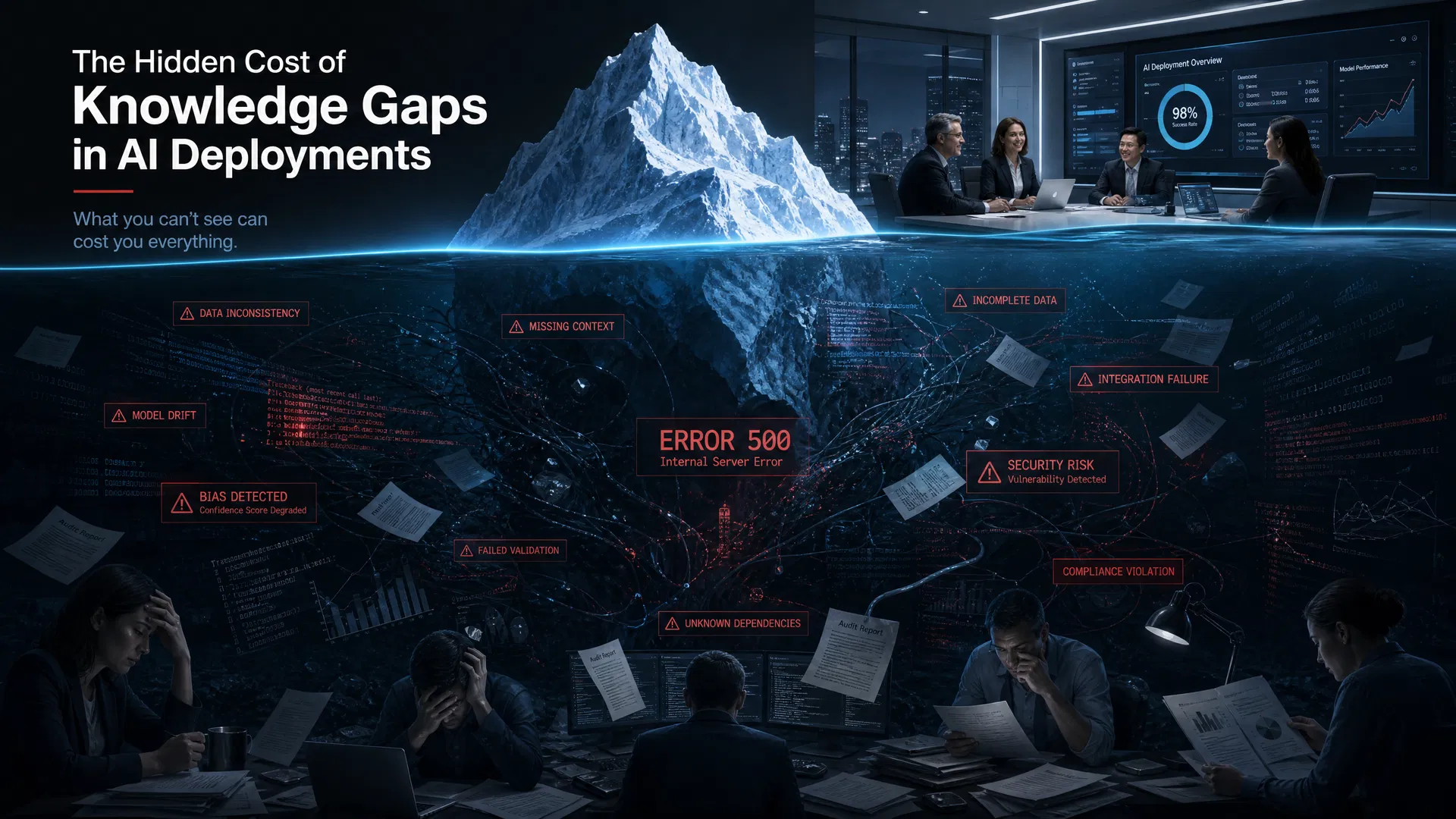
A manufacturing company's operations director told me recently that their AI assistant had saved the business approximately 40 hours of staff time per week. He was pleased with this figure. When I asked how they had calculated it, he described a simple time-tracking exercise: staff logged the queries they had redirected to the AI and estimated the time they would have spent answering them manually.
What the calculation did not include was the time spent by senior engineers reviewing the AI's responses before they were acted upon. It did not include the three incidents in the previous quarter where the AI had provided technically plausible but operationally incorrect guidance on maintenance procedures. And it did not include the cost of the near-miss that had prompted the introduction of the mandatory review process in the first place.
The real figure, once these costs were incorporated, was closer to a net neutral. The AI was saving time in one part of the system and consuming it in another, with the added variable of operational risk that had not existed before the deployment.
This is the hidden cost of knowledge gaps in AI deployments — and it is systematically invisible in the metrics organisations use to evaluate AI performance.
The fundamental problem with knowledge gaps in AI systems is that they do not announce themselves. A system with a knowledge gap does not return an error message. It returns a response — often a well-structured, confident, fluent response — that happens to be incomplete, outdated, or wrong in a domain-specific way that requires expert knowledge to identify.
This creates a measurement problem that is genuinely difficult to solve. Standard AI performance metrics — response rate, user satisfaction scores, query resolution rates — are all downstream of the knowledge gap. They measure whether the AI produced a response that the user found satisfactory, not whether the response was accurate. In many professional contexts, users are not in a position to evaluate accuracy independently. That is, in fact, why they are using the AI.
The result is that organisations can accumulate significant exposure to knowledge-gap risk while their performance dashboards show green across every metric they are tracking.
Understanding the specific forms that knowledge gaps take is the first step toward building systems that are genuinely reliable rather than superficially impressive.
Temporal gaps arise when an AI system's knowledge is anchored to a training cutoff that predates significant changes in the domain. In regulatory environments, this is a critical vulnerability. A system trained on data from 18 months ago may be operating with outdated guidance on compliance requirements, technical standards, or procedural obligations. The system does not know what it does not know — it answers questions about current requirements using historical knowledge, with no indication that the information may have changed.
Depth gaps arise when a system has broad but shallow knowledge of a domain — enough to produce plausible responses to general questions, but insufficient to handle the specific, granular, edge-case queries that arise in professional practice. A legal AI that can explain the general principles of contract law but cannot reliably interpret the specific provisions of a particular regulatory framework is not a legal AI in any meaningful professional sense. It is a sophisticated search engine with a fluency problem.
Contextual gaps arise when a system lacks the organisational-specific knowledge required to apply general domain expertise to a particular business context. The same question — "what is the correct procedure for handling this type of customer complaint?" — has different answers in different organisations, different regulatory jurisdictions, and different operational contexts. A system without this contextual knowledge will provide a generically correct answer that may be operationally wrong for the specific situation.
What makes knowledge gaps particularly dangerous in professional AI deployments is not their individual impact but their compounding effect over time.
A single knowledge gap in an isolated query is a manageable problem. The user gets a wrong answer, realises it is wrong, and corrects it. The cost is the time spent on the correction.
But knowledge gaps do not operate in isolation. In a professional context, AI outputs are frequently used as inputs to subsequent decisions. An incorrect answer to a compliance query shapes the drafting of a policy document. An operationally wrong maintenance recommendation influences a scheduling decision. A technically plausible but inaccurate financial analysis informs a capital allocation choice.
Each of these downstream decisions carries the error forward, often in ways that are not visible until the consequences materialise. By that point, tracing the error back to the original knowledge gap in the AI system requires a forensic investigation that most organisations are not equipped to conduct.
This is the compounding effect of knowledge gaps — and it is the reason why the cost of a poorly engineered AI deployment is almost always higher than it appears in the immediate aftermath.
The purpose of expert knowledge engineering is not to eliminate knowledge gaps entirely — that is not achievable in any complex domain. The purpose is to make knowledge gaps visible, bounded, and manageable.
A well-engineered AI agent knows what it does not know. It has been designed with explicit boundaries around its domain of reliable knowledge, and it has been trained to recognise when a query falls outside those boundaries and to respond accordingly. This is not a trivial capability — it requires significant design work and ongoing maintenance — but it transforms the risk profile of the deployment fundamentally.
The difference between "I don't know" and a confident wrong answer is not just a matter of accuracy. It is a matter of the downstream decisions that the response enables. A system that acknowledges uncertainty allows the user to seek additional information. A system that provides confident wrong answers does not.
At IntelliAgent, the knowledge boundary design process is one of the most intensive phases of agent development. It involves systematic mapping of the domain's edge cases, adversarial testing to identify the queries most likely to produce confident but incorrect responses, and explicit design of the agent's uncertainty communication — how it signals the limits of its knowledge in ways that are useful rather than simply unhelpful.
The standard ROI calculation for AI deployments measures the value of the work the AI does. It does not measure the cost of the work the AI does incorrectly, or the cost of the verification processes required to catch those errors, or the cost of the trust erosion that occurs when errors are discovered.
A more complete ROI calculation would include four components. First, the value generated by accurate, reliable AI responses — the genuine productivity gain from queries that are answered correctly and acted upon without additional verification. Second, the cost of verification overhead — the time spent by human experts reviewing AI outputs before they are acted upon. Third, the cost of error remediation — the time and resource required to identify and correct decisions that were made on the basis of incorrect AI outputs. Fourth, the cost of trust erosion — the reduction in AI utilisation that follows from visible failures, and the consequent loss of the productivity gains that reliable AI would have generated.
When organisations calculate AI ROI using only the first component, they systematically overestimate the value of their deployments. When they include all four components, the picture changes significantly — and the investment case for expert-trained agents, which minimise components two, three, and four, becomes considerably stronger.
Three implications follow for organisations evaluating or managing AI deployments.
The first is that verification overhead should be measured explicitly and included in AI performance calculations. If your team is spending time reviewing AI outputs before acting on them, that time is a cost of the deployment, not a separate activity. Measuring it will give you an accurate picture of the net value the AI is generating.
The second is that knowledge gap incidents should be logged and analysed systematically. Most organisations treat AI errors as isolated events to be corrected and forgotten. Treating them as data — tracking their frequency, their domain, their downstream impact — gives you the information needed to identify where knowledge engineering investment is most urgently required.
The third is that the knowledge engineering investment should be evaluated against the full cost of knowledge gaps, not just the cost of the engineering work itself. The question is not "how much does it cost to build an expert-trained agent?" but "how much does it cost to operate a deployment with unmanaged knowledge gaps?" In most professional contexts, the answer to the second question makes the answer to the first look modest.
The operations director I mentioned at the beginning has since commissioned a more complete analysis of his AI deployment's performance. The results are, by his own description, uncomfortable.
The question he is now asking — and the question worth asking in any professional AI deployment — is not "how much time is the AI saving?" but "how much of the time it saves is being consumed by the verification and remediation work that its knowledge gaps require?"
The answer to that question is the real measure of whether your AI deployment is generating value or redistributing cost.
Get in Touch
Speak with our team about building a custom AI agent for your business.
Start a Conversation