A financial services firm deployed a general-purpose AI assistant across its advisory team last year. The system was capable, well-resourced, and came with an impressive vendor demonstration. Within six weeks, the team had quietly stopped using it. Not because it was unintelligent — it was, by most measures, remarkably capable. They stopped using it because it was wrong in ways that were difficult to detect, and in financial services, that is a category of failure you cannot afford.
The agent answered questions about regulatory obligations with the confidence of a compliance officer and the accuracy of someone who had read a summary of a summary. It produced plausible-sounding responses that required expert verification before every use. The team calculated that checking the AI's output was taking longer than simply doing the work themselves.
This is not an unusual story. It is, in fact, the dominant pattern in enterprise AI adoption right now — and understanding why it happens is the first step toward building something that actually works.
General-purpose large language models are trained on vast quantities of text from across the internet, academic databases, and digitised books. This breadth is their greatest strength and their most significant liability. They know a great deal about a great many things, and they have no reliable mechanism for distinguishing between what they know precisely and what they know approximately.
In everyday consumer applications, this is a manageable limitation. If a general AI assistant gives you a slightly inaccurate recipe suggestion, the cost is negligible. In a professional context — compliance, clinical guidance, legal interpretation, financial analysis, technical support — the cost of a confident but imprecise answer can be substantial.
The technical term for this phenomenon is hallucination, but that word understates the problem. The AI is not hallucinating in the sense of producing obviously nonsensical output. It is producing fluent, well-structured, internally consistent responses that happen to be wrong in ways that require domain expertise to identify. This is a fundamentally different failure mode from a system that says "I don't know."
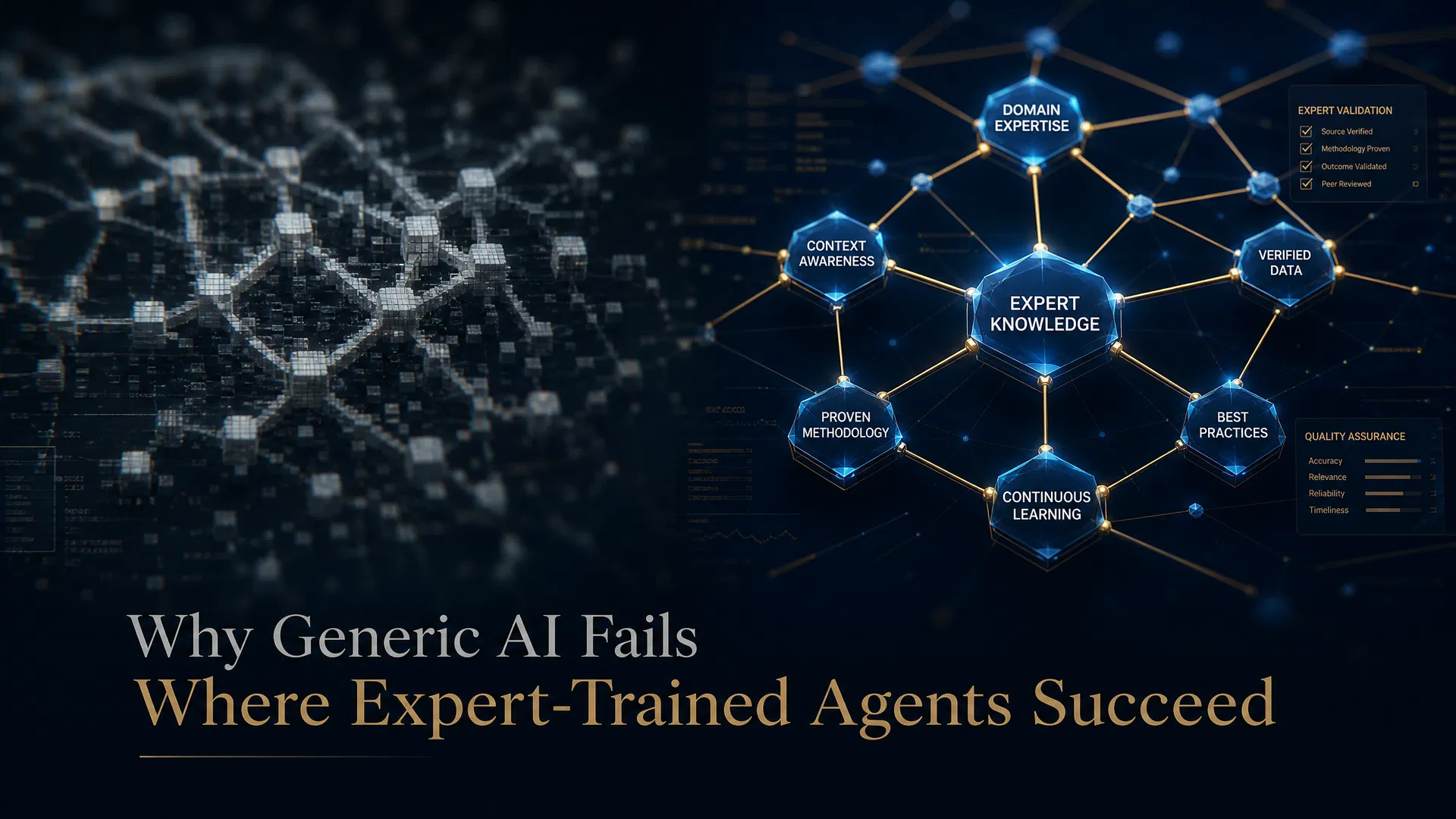
When we talk about an expert-trained AI agent, we are not talking about a general model that has been given a longer system prompt. We are talking about a fundamentally different approach to how the agent's knowledge is structured, bounded, and validated.
The distinction begins at the knowledge architecture level. A generic AI draws on everything it has ever been trained on, weighted by statistical frequency. An expert-trained agent draws on a curated, verified, domain-specific knowledge base that has been built by people who understand both the subject matter and the failure modes of AI reasoning in that domain.
At IntelliAgent, every agent we build goes through a structured knowledge engineering process led by a team with MBA and PhD-level expertise. This is not a differentiating feature we have added for marketing purposes — it is the foundational requirement for building an agent that performs reliably in a professional context.
The process involves four distinct phases. First, domain mapping: identifying the precise boundaries of what the agent needs to know, what it should decline to answer, and what adjacent topics it should redirect rather than attempt. Second, knowledge curation: selecting, structuring, and validating the source material that will form the agent's knowledge base. Third, reasoning pathway design: determining how the agent should handle ambiguity, incomplete information, and questions that fall at the edge of its competence. Fourth, adversarial testing: systematically attempting to elicit incorrect, misleading, or out-of-scope responses before the agent is deployed.
The financial services firm in the opening example did not lose money on a failed AI project in the conventional sense. They did not have a visible incident. What they lost was more insidious: six weeks of productivity, the opportunity cost of a team that had briefly believed AI could transform their workflow, and the institutional scepticism that now makes every subsequent AI proposal harder to advance.
This pattern — the invisible cost of the failed deployment — is systematically underestimated in AI investment decisions. Organisations calculate the cost of the software licence and the implementation project. They rarely calculate the cost of the trust deficit that a poorly performing AI creates in the teams that use it.
Research on technology adoption in professional services contexts consistently shows that a single high-profile failure of an automated system creates a credibility gap that takes 18 to 24 months to close, even when the underlying system has been substantially improved. The first deployment is not just a technical decision — it is a cultural one.
There is a counterintuitive dynamic at work in enterprise AI adoption. The organisations with the most sophisticated technical teams are often the most vulnerable to the generic AI failure pattern, because they have the capability to deploy quickly and the confidence to assume that general capability translates to domain-specific reliability.
A smaller organisation with less technical resource tends to move more cautiously, ask more questions about what the AI actually knows, and test more thoroughly before deployment. A large organisation with a dedicated AI team and executive pressure to demonstrate AI ROI tends to move faster and test less rigorously.
The result is that the organisations investing the most in AI are, in many cases, generating the most visible failures — and those failures are shaping the cultural narrative around AI reliability in ways that will affect adoption decisions for years.
There are three distinct dimensions along which an expert-trained agent differs from a generic deployment, and understanding these distinctions is useful for any organisation evaluating AI investment.
Knowledge depth refers to the granularity and accuracy of the agent's domain knowledge. A generic AI knows that a particular regulation exists. An expert-trained agent knows the specific provisions of that regulation, the interpretive guidance that has been issued, the edge cases that have been tested in enforcement, and the practical implications for the specific business context in which it is operating.
Knowledge boundaries refer to the agent's ability to recognise the limits of its competence. This is, paradoxically, one of the most technically demanding aspects of expert training. Teaching an AI system to say "I don't know" or "this is outside my area of reliable knowledge" requires explicit design work. Generic models are optimised for helpfulness, which means they are systematically biased toward providing an answer even when the honest response is uncertainty.
Contextual calibration refers to the agent's ability to adapt its responses to the specific organisational context in which it operates — the terminology the organisation uses, the processes it follows, the regulatory environment it operates in, and the level of technical sophistication of the people it is serving. This cannot be achieved through a general model with a brief configuration. It requires sustained knowledge engineering work.
Three practical implications follow from this analysis.
First, the evaluation criteria for AI agents in professional contexts should be inverted from the standard consumer benchmark. The question is not "how often does this agent produce a useful response?" but "how often does this agent produce a response that is both useful and reliably accurate?" These are different questions, and the gap between them is where professional deployments fail.
Second, the knowledge engineering investment is not a cost to be minimised — it is the primary determinant of whether the deployment generates value or erodes trust. Organisations that treat knowledge engineering as a one-time setup task rather than an ongoing discipline will find their agents degrading in quality as the business context evolves.
Third, the team building the agent matters as much as the technology. An agent built by people who understand both the domain and the failure modes of AI reasoning in that domain will outperform an agent built by capable technologists who lack domain expertise, regardless of the underlying model capability.
Before your organisation deploys its next AI agent, the question worth asking is not "what can this AI do?" but "what does this AI know — and how do we know that it knows it?"
The difference between a generic AI deployment and an expert-trained agent is not primarily a question of technology. It is a question of intellectual rigour applied to the knowledge architecture before the first user interaction takes place.
The organisations that will generate sustained value from AI in professional contexts are those that treat knowledge engineering as a core competency — not a configuration task. That work requires expertise, time, and the willingness to build something properly rather than quickly.
The cost of building it properly is predictable. The cost of building it quickly and getting it wrong is not.
See How It Works
Try a live demonstration of an expertly trained AI agent right now — no sign-up required.
View Live Demos