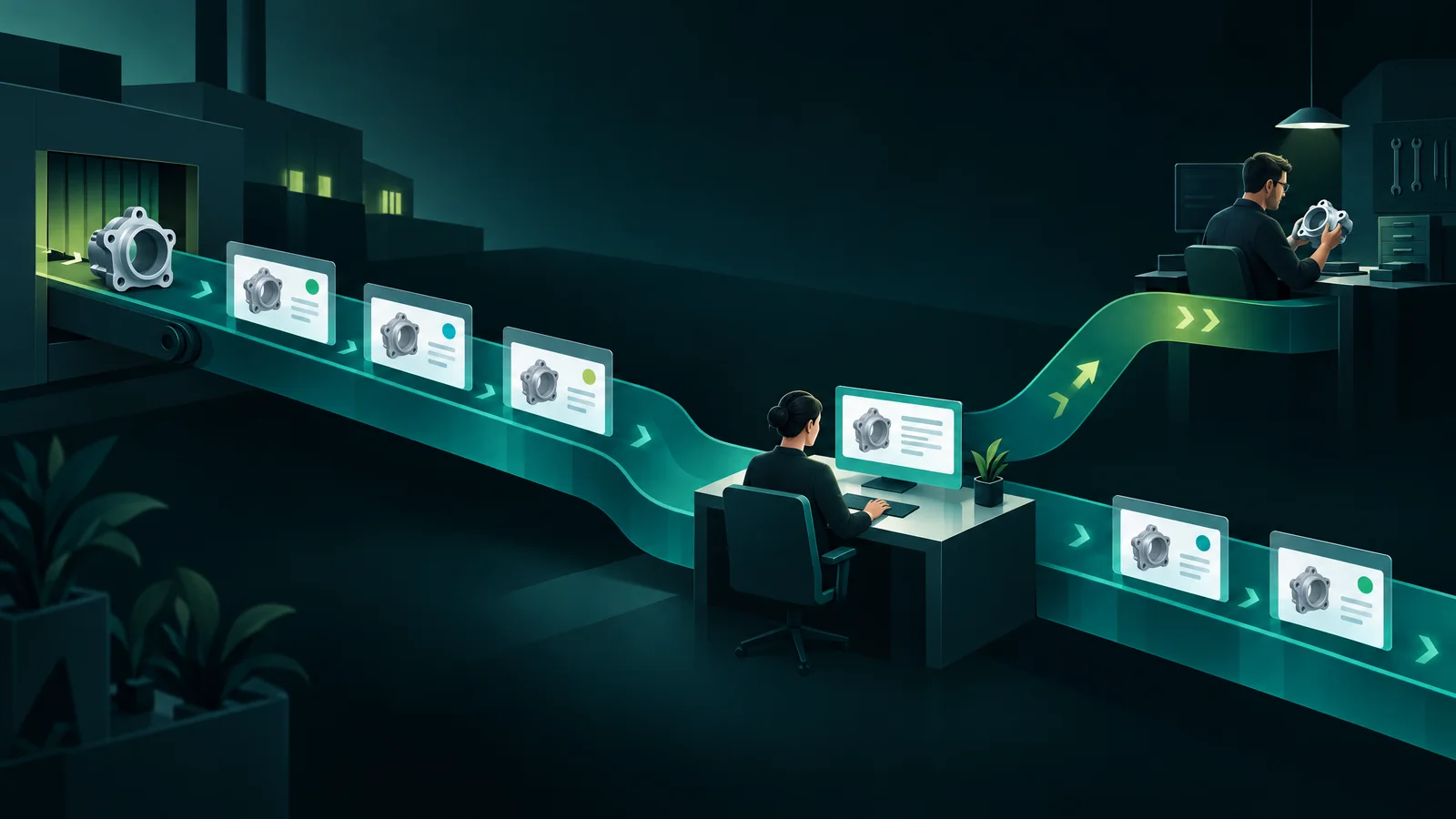
Illustrative business scenario—not a reported client result.
Yes—but only if it is given a narrow job, approved information and an obvious route to a person. The problem is rarely that nobody can answer delivery or specification questions. Repeat questions interrupt people needed for matters requiring judgement.
The familiar manufacturing support backlog
Consider an illustrative component manufacturer. Its customer-service team receives recurring questions about product dimensions, compatible materials, lead times, returns and delivery status. Engineers are copied into emails because the support team does not want to guess. When an enquiry is unclear, a customer may repeat the same background to three different people.
That is not a failure of effort. It is a failure to separate routine information from technical judgement. A customer asking where an order is may need an approved status update. A customer asking whether a component is suitable for a safety-critical use needs someone with the authority and expertise to assess the request.
Why a bigger FAQ or generic chatbot fails
The common fix is to add more help-centre pages or place a general chatbot on the website. Both may reduce some simple questions. Neither reliably decides whether an answer is current, whether the question falls outside a published policy, or whether the customer is asking for an exception.
A generic assistant also creates a subtler problem: it can make an uncertain answer sound complete. In manufacturing, an apparently small detail about a specification, availability or return can carry a commercial or technical consequence. The aim should not be to make the system sound more certain. It should be to make the system stop at the right point.
The bounded change: an agent with approved answers
A useful first version could handle a small set of repeatable enquiries. It would retrieve answers only from an approved knowledge base: the current product information, published returns process and authorised delivery updates. A knowledge base here simply means the controlled set of documents and records the agent is allowed to use.
For a delivery question, the system could identify the order reference, check whether the customer has provided the information needed to locate it, and prepare a factual reply from the authorised status source. For a published product dimension, it could point to the relevant approved specification. It should not make up a substitute material, confirm a future delivery date that the source does not confirm, alter an order, or approve a return.
The existing guide on building the escalation path before a customer-support agent explains why this distinction matters. The agent is only one part of the service; operating design makes its answer or hand-off accountable.
Keep technical and commercial judgement with people
The stop list should be designed before the agent answers a live customer. It can include complaints, damaged goods, warranty disputes, safety or installation questions, requests to change a price or delivery commitment, conflicting product information, low-confidence matches and a direct request to speak to a person.
Each stop needs an owner. The agent can acknowledge the question, gather only the information the receiving team needs and create a concise case for the right role. It should state that the issue has been passed on, rather than invent a resolution or a response deadline.
This is consistent with the ICO’s guidance that data protection should be considered at design stage and throughout a system’s lifecycle, and that use of personal information should be limited to what is necessary for a specific purpose 1. A support workflow therefore needs decisions about its permitted records, access roles and retention before it connects an order or customer history. That is a design discipline, not a claim that a particular implementation is compliant.
The potential payoff should be measured, not assumed
The possible gain is released capacity: fewer routine replies drafted from scratch and less re-explaining when a case needs a person. It is not automatically a cash saving, a reduced headcount or better customer satisfaction. Those claims need evidence from the business itself.
Start with a baseline over a defined period. Record the share of enquiries in the chosen routine categories, staff handling time, time to first useful response, repeat contacts, escalations and reviewer corrections. Add a simple qualitative check: did the hand-off contain enough context for the person to act without asking the customer to start again?
Review the results against a comparable period, while noting changes in order volume, product launches or seasonal demand. If the agent generates repeated corrections on a product topic, the lesson may be that the source information or process needs repair. It is not a reason to give the system more authority.
Control access before connecting order data
The agent should receive the least access required for its stated task. An assistant that retrieves an approved order status does not need permission to edit delivery addresses, change payment details or issue credits. The application should enforce these permissions rather than rely on the model to decide what is allowed.
The NCSC frames secure AI work across design, development, deployment and operation, including logging and monitoring after deployment 2. NIST likewise presents generative-AI risk management as a voluntary, lifecycle-wide way to build trustworthiness considerations into design, development, use and evaluation 3. For a small support pilot, the practical translation is modest: map the data, narrow the tools, test difficult cases, log meaningful exceptions and keep a human owner for changes.
Could this fit your support desk?
Begin with one repeatable question type, one approved source set and one clear escalation route. The most useful next conversation is not “can we automate support?” It is “which questions are routine enough to prepare safely, and where must a person decide?”
For an indicative starting scope for a trained agent or connected system, get your indicative price range — no call required.
Sources
- Data protection by design and by default — Information Commissioner’s Office
- Guidelines for secure AI system development — National Cyber Security Centre
- Artificial Intelligence Risk Management Framework: Generative Artificial Intelligence Profile — NIST
Next step
Get your indicative price range — no call required
Answer a few questions and see an indicative price range for a trained agent or connected webstack — every scope checked by our MBA and PhD experts.
Get your indicative price range — no call required