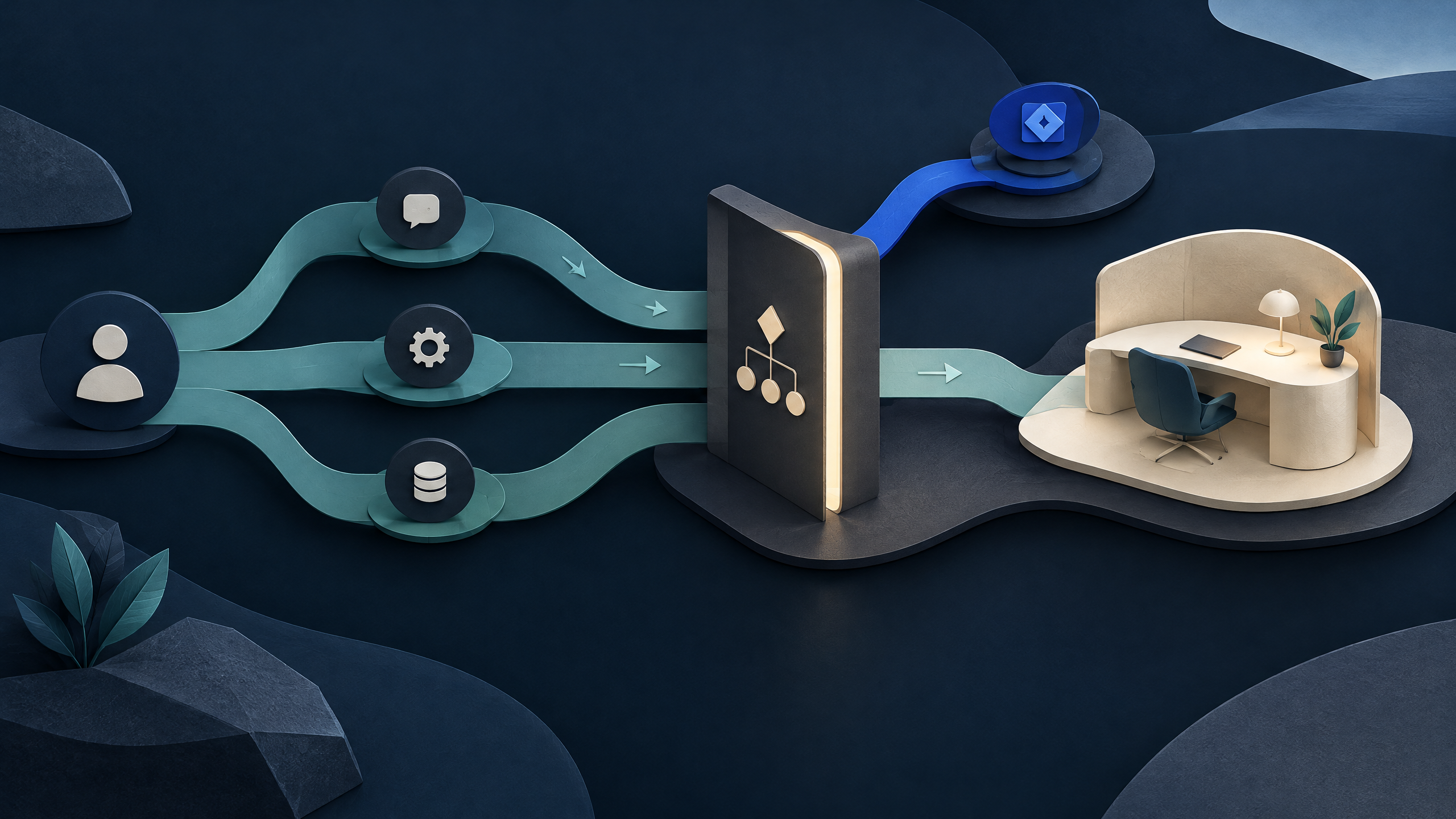
AI customer support agent implementation UK often starts at the wrong end: a backlog makes a conversational agent look obvious. The first work becomes selecting a model, loading a help centre and setting its tone. The operational question is deferred: when it should stop, who takes over, and what context travels with the case?
That omission creates a familiar failure mode. The agent can answer a routine delivery-status or password-reset question, but a customer then mentions a duplicate charge, a vulnerable situation, a cancellation dispute or a promised exception. The system either continues with a plausible but unsuitable answer, or sends a vague ‘contact us’ message that drops the context. Neither outcome repairs the support operation.
A governed implementation treats the agent as one controlled step in a support service, not as the service itself. The design starts by mapping escalation and human authority, then gives the agent a limited role within that path. That is how a founder or COO can address repetitive enquiries without handing commitments, exceptions or consequential decisions to a probabilistic system.
AI customer support agent implementation UK starts with a stop list
The first useful artefact is not a prompt. It is a decision map for the existing support queue. Take a representative sample of enquiries and classify each by both intent and authority. ‘Where is my order?’ may be answerable from a current, approved status source. ‘Can you waive the cancellation charge?’ is a request for discretion. ‘Why was I refused?’ may require a trained person to examine the case and explain the decision through the organisation’s established process.
The resulting stop list should name the triggers that move a conversation out of the agent’s scope. Typical triggers include an explicit complaint; payment or account-security concern; safeguarding, distress or threat language; a request to alter a contract, policy or price; uncertainty between two approved answers; a low-confidence match to the customer’s question; and a direct request for a person. The service owner owns this list because it defines service authority.
Not every support interaction needs a reviewer; the point is to reserve human judgement for commitments, exceptions and potentially sensitive issues. The ICO’s AI audit guidance describes meaningful human review as requiring reviewers with suitable knowledge, authority and independence, and recommends documented procedures, override logs and a fallback option where the system’s competence is questioned 1. Those ideas are directly useful for a support escalation lane even when the agent is not making a solely automated decision.
A concise escalation specification answers five questions for each trigger: what signals it; what the agent may say before hand-off; which queue or role owns the case; what case context is passed; and whether the agent must cease interaction while the customer waits. It also distinguishes ‘urgent’ from ‘important’. A suspected account takeover may need a different route and response pattern from a complex but ordinary product query.
Design the hand-off as a case, not a dead end
An escalation message alone is insufficient. The receiving colleague needs a compact, reviewable case: conversation transcript or relevant turns, customer and order identifiers only where necessary, detected trigger, approved sources consulted, the answer draft if one exists, and the reason the agent stopped. The customer needs a clear next step, without an invented time commitment.
Consider a UK subscription business. Its first release is limited to account-access guidance, plan information and status questions that can be answered from an approved help source and a current account-status integration. A customer asks to end a plan because they believe an earlier cancellation request was ignored. The word ‘cancel’ is not itself the important signal; the issue is a disputed prior interaction and a request that could change a commercial position. The agent should acknowledge the issue in neutral language, create a case with the conversation context, route it to the team authorised to investigate, and avoid declaring the contract ended.
This preserves the value of the system. The agent still gathers the issue in a consistent form and reduces re-explanation. The person receives enough context to begin review. Most importantly, the implementation makes clear where the commitment point sits. It does not disguise a business decision as text generation.
The queue must be resourced before launch. Assign an accountable owner for each route, define coverage and a fallback where the destination is unavailable, and give reviewers authority to correct the proposed path. The ICO advises that reviewer caseload and resourcing should allow appropriate time for review, and that organisations should maintain logs where a human overrides an AI decision 1. In a support workflow, those override reasons become a practical input to improving the stop list and knowledge base—not a licence to silently expand the agent’s authority.
Give the agent a narrow evidence boundary
A support agent needs a smaller information boundary than an internal research assistant. For each in-scope intent, define the approved answer source, the fields it may read, the permitted action, and the response it may send. A policy article may support an explanation of returns; it should not be treated as permission to approve an exception. A status endpoint may support a factual update; it should not give the agent the ability to alter an address, payment method or entitlement.
The UK NCSC’s secure AI development guidance recommends threat modelling, controls over data sent to external services, checks and sanitisation of inputs, least-privilege access, and restrictions where AI components can trigger actions 2. Applied here, that means separating answer retrieval from operational tools, using narrowly scoped service credentials, and making high-impact changes unavailable to the agent or subject to a human approval step. It also means documenting how prompts, logs, source material and feedback are handled 2.
The boundary matters because customer messages can be adversarial as well as ambiguous. OWASP notes that prompt injection can alter an LLM’s intended behaviour and can lead to outcomes such as disclosure of sensitive information or unauthorised use of available functions; retrieval or fine-tuning does not fully remove that risk 3. A customer-support implementation should therefore regard customer text and externally supplied content as untrusted. The application, not the model, should enforce identity checks, entitlements, permissions and action approval.
Test the escalation path before expanding the answer set
A useful pilot is designed around cases that should stop, not just the questions that make the agent look capable. Build a test pack from historic, suitably handled support patterns and newly written challenge cases. Include ordinary repeat questions, incomplete questions, conflicting policy wording, frustrated customers, suspicious instructions, requests for exceptions and messages that should route immediately to a person. Do not feed real customer material into an informal test environment simply for convenience.
For every test, record the intended route, sources the agent was allowed to use, expected response constraint, actual response, whether a case was created, the destination queue, and whether a reviewer would have overturned the result. Review the failures by category: missed escalation, unnecessary escalation, wrong source, unsupported assertion, incomplete context hand-off or unsafe tool attempt. These observations are not a promise of an error rate.
NIST frames AI risk management as an ongoing effort to incorporate trustworthiness considerations into the design, development, use and evaluation of AI systems, and provides the voluntary AI RMF alongside a generative-AI profile 4. For a support operation, that is a useful discipline: map the bounded use case and affected people; measure the pilot against its documented routes; manage defects and changes; and maintain governance over the work. It prevents a successful demo from becoming the only acceptance criterion.
Use a staged release. Start with a small number of repeatable, low-authority intents. Monitor the escalation reasons and reviewer feedback. Add an intent only when its source, hand-off and owner are clear. If the agent is repeatedly stopped for the same reason, the correct response may be to improve the underlying policy, support content or queue design—not to instruct the model to be more assertive.
The buyer decision is operational, not conversational
The right implementation partner should be able to discuss the queue, commitments, ownership and exceptions before discussing agent personality. Ask to see how an escalation trigger becomes a reviewable case, how the case reaches an accountable person, what the agent can and cannot access, and how changes to sources or rules are tested. Those questions distinguish a chat interface from an operating workflow.
For wider context on building bounded, accountable systems, see the Neuro-Performance AI Insights. If you have a defined support backlog and want to scope a governed pilot around it, request an architecture audit. The practical next step is a working session that maps a small set of intents, the stop list, source boundaries and the human owners—not a promise that an agent can resolve every customer conversation.
Sources
Related insights
- Knowledge Based Agent in Artificial Intelligence: Turning Approved Information Into a Useful Business Guide
- AI Agents and Automation: How to Keep the Human Decision Where It Belongs
- Human in the Loop AI Development Services UK: Where Expert Review Actually Belongs
Sources
Next step
Request an architecture audit
A free 30-minute review of where AI agents and a connected webstack could remove work from your business — checked by our MBA and PhD experts.
Request an architecture audit