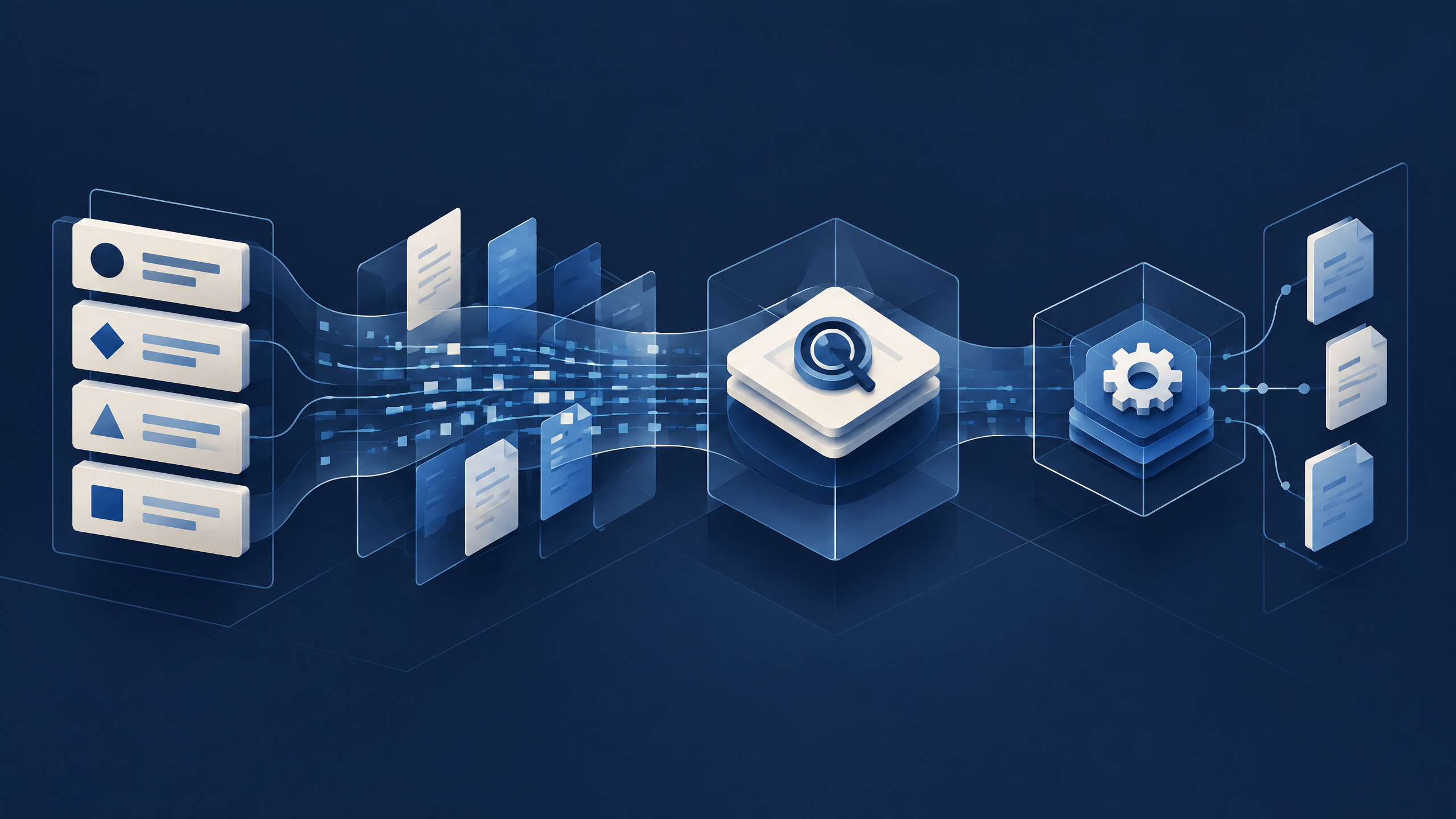
Intelligent Agent Types: a useful operating distinction
Intelligent Agent Types are often explained as a ladder from simple rules to systems that reason about goals. That is a helpful starting point, but it misses the operational question facing a UK founder or COO: what authority should this system have in a live workflow? A team may want faster enquiry handling, cleaner reporting or more consistent internal answers. The failure mode is not that an agent is insufficiently clever; it is that it is given broad data access or the power to act before its remit, evidence and owner are clear.
In business terms, an agent is not just a model. It is a workflow that can receive an event, consult information, select a next step and sometimes use a tool. The NCSC notes that agentic systems may access data sources, retain context, make decisions, use tools and act towards a goal; those capabilities also widen the potential attack surface and make behaviour harder to test and govern 4. The sensible design response is to match the agent type to a bounded job, rather than treating every process as a case for autonomy.
For implementation planning, five types provide a useful working vocabulary. They are not mutually exclusive and a single workflow may use more than one.
- Rule-based agents apply explicit conditions: “if a web enquiry names an existing customer, route it to the account queue”. They are predictable and suitable for stable, high-volume routing.
- State-aware agents use a controlled view of context, such as CRM stage, consent status or an approved service catalogue, before proposing a next step.
- Knowledge-grounded agents retrieve from an approved, versioned information set to prepare an answer or summary. Their value depends on source selection and retrieval design, not on a claim to universal knowledge.
- Goal-directed agents plan a sequence across tools—for example, gathering a brief, drafting a follow-up and creating a review task. They need tighter action boundaries because a plan can span several systems.
- Optimising or learning agents rank alternatives against a defined objective, such as prioritising low-risk support tickets. They require especially careful evaluation where the ranking could affect people, revenue recognition or resource allocation.
This is a delivery taxonomy, not a promise that a more advanced type is automatically better. A basic routing rule may be the best solution where the decision is repeatable. Conversely, a knowledge-grounded drafting assistant can be valuable where variation is real but publication or commitment remains human-owned.
The business problem is not intelligence—it is authority
Consider a professional-services firm whose enquiries arrive through a website form, several shared inboxes and introductions from partners. Staff need to recognise the enquiry, check whether it is an existing relationship, assemble relevant context and arrange a response. A rush to a fully autonomous sales agent could combine duplicate records, draw on stale collateral, make an unsuitable claim or send a message from the wrong mailbox.
A governed workflow separates useful preparation from accountable commitment. A simple rule can acknowledge receipt and assign a queue. A state-aware step can identify the CRM record and missing information. A knowledge-grounded step can draft a response from the approved proposition and service documents. A person then checks the draft, chooses the commercial position and sends it. If a later goal-directed agent creates follow-up tasks, it should do so only within named systems, time windows and permission scopes.
That separation matters because an AI system is an operational interface around models, data and technical processes—not merely the model itself 3. The UK Government’s AI Management Essentials (AIME) is explicitly concerned with organisational processes and does not treat a self-assessment as certification or compliance 3. For founders, this is a practical reminder: buying a capable model does not settle ownership, evidence quality or escalation.
When personal data or decisions about individuals are involved, the bar rises again. The ICO’s guidance is aimed at organisations using AI to support or make decisions about people and includes senior-management roles, policies, procedures and documentation for meaningful explanations 5. In a first implementation, avoid using an agent to make unreviewed hiring, credit, disciplinary or other high-consequence decisions. Use it to organise evidence, identify omissions or prepare a reviewer’s pack instead.
A bounded pattern: classify, prepare, recommend, escalate
A robust route from simple rules to useful agency is a four-stage pattern:
- Classify the event. Ingest a form submission, email or ticket; check required fields; identify the workflow and data sensitivity. This is often deterministic automation, not a reasoning problem.
- Prepare a controlled working record. An ETL step can extract defined fields from source systems, standardise formats, remove duplicates and load a limited case record. Preserve source identifiers, timestamps and data-quality flags so the workflow does not present an inferred record as fact.
- Recommend within an evidence boundary. The agent retrieves only the approved sources for that job, produces a draft, and labels missing evidence or uncertainty. For an inbox workflow, the output might be: proposed category, cited internal source, draft reply and a confidence-related review flag—not an irreversible customer commitment.
- Escalate or execute under a policy. Low-risk, reversible actions may proceed with logged permissions. Exceptions, sensitive data, novel requests, pricing changes or high-impact outcomes go to a named human. The system should be able to stop, hand over and preserve the record of why.
The pattern makes ETL and webstack design visible. The webstack supplies clear intake, consent-aware forms, routing and a usable human review surface. ETL creates a reliable, governed data path between systems. The agent operates on that bounded layer rather than treating every connected folder, inbox or database as open-ended context. This reduces the risk of unsupported answers and limits the impact of an incorrect classification, while still reducing manual assembly work.
Five governance gates before an agent receives live access
The following founder-level gate is deliberately plain. It can be applied to a single pilot without pretending to certify the organisation.
| Gate | Decision to make | Evidence to retain | |---|---|---| | Job | What precise, low-risk task is the agent permitted to perform? | A workflow statement and excluded outcomes. | | Knowledge | Which sources are approved, who owns them and how are they refreshed? | Source register, version dates and access rules. | | Authority | Can it draft, recommend, create a task, or send/change something? | Role permissions, approval thresholds and least-privilege scope. | | Assurance | How will normal, edge and adversarial cases be tested? | Test cases, observed failures and acceptance criteria. | | Accountability | Who monitors it, receives exceptions and can stop it? | Named owner, logs, escalation path and incident procedure. |
NIST’s AI Risk Management Framework is voluntary guidance for incorporating trustworthiness considerations into AI design, development, use and evaluation 1. Its companion generative-AI profile highlights governance, pre-deployment testing, content provenance and incident disclosure, and recommends tracking reported errors, near-misses and negative impacts 2. These references support a habit that is often more valuable than a complex diagram: record the intended boundaries before connecting tools, then revise them when testing or live evidence shows a gap.
The NCSC’s recent adoption guidance makes the same operational point: begin with tightly bounded, clearly defined low-risk pilots, maintain meaningful oversight, use least privilege and plan for incidents 4. Monitoring is not an afterthought. A workflow owner needs enough logging to see what source was used, what action was proposed or taken, who approved it and whether a later correction was required. Logging should be designed proportionately and with appropriate data handling, rather than used as a reason to retain everything indefinitely.
How to choose the right type and expand safely
Start with the smallest agent type that solves the bottleneck. If the task has stable inputs and a known answer, use rules or conventional automation. If staff repeatedly search approved documents and compose similar drafts, a knowledge-grounded assistant with reviewer approval may be appropriate. Only consider a goal-directed workflow when its tools, permissions, rollback and owner are explicit. A learning or optimisation component should follow only when there is a defensible objective, enough quality data and a way to evaluate whether its recommendations worsen outcomes for a group or process.
Expansion should be evidence-led: pilot one queue, one data class and one measurable service objective; sample outputs and exceptions; update the source set and controls; then decide whether another action is justified. This is not a path to perfect output or frictionless compliance. It is a way to keep accountable decisions with people while making repetitive preparation, triage and follow-up more reliable.
Neuro-Performance AI designs conversion-engineered webstacks and governed agent workflows around those boundaries: source selection, ETL, role-based actions, review points and continuous improvement. See how the service works for the delivery approach. If you are deciding which part of a workflow should remain a rule, become a reviewed agent step, or stay human-owned, request an architecture audit to discuss a bounded pilot.
Sources
Sources
- [1]NIST AI Risk Management Framework — National Institute of Standards and Technology
- [2]Artificial Intelligence Risk Management Framework: Generative Artificial Intelligence Profile — National Institute of Standards and Technology
- [3]Guidance for using the AI Management Essentials tool — UK Department for Science, Innovation and Technology
- [4]Thinking carefully before adopting agentic AI — National Cyber Security Centre
- [5]Explaining decisions made with AI — Information Commissioner's Office
Next step
Request an architecture audit
A free 30-minute review of where AI agents and a connected webstack could remove work from your business — checked by our MBA and PhD experts.
Request an architecture audit