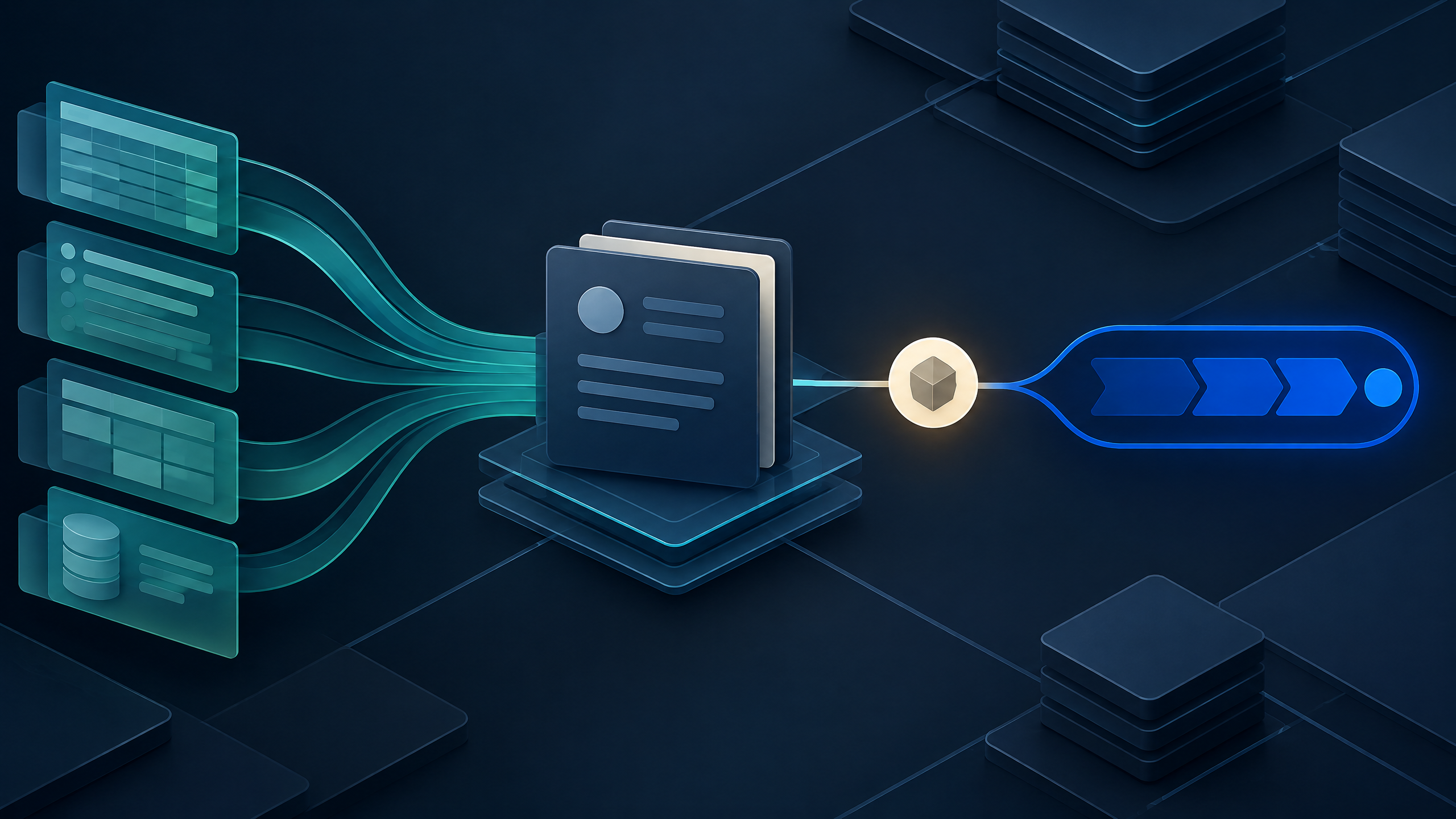
A website can collect an enquiry, but it cannot by itself decide what record should exist, who owns the next step, what information is missing, or whether an action is ready to be taken. That gap is where otherwise promising enquiries end up in a shared inbox, a spreadsheet and several unconnected tools. For a UK business considering web application development with AI agents UK, the practical requirement is not a more elaborate digital brochure. It is a bounded operating system for one defined business journey.
The distinction matters. An agent attached to a form can write a plausible summary, yet still leave staff to search for context, reconcile duplicates and decide whether the summary is safe to act on. A useful implementation makes the application the reliable home for workflow state and makes the agent a constrained participant in that workflow. The result should be a reviewable route from structured input to accountable action, not an autonomous layer bolted onto the front end.
What web application development with AI agents UK should connect
Start with one high-value journey that currently crosses channels. For example, a regional professional-services firm may receive a prospective-client enquiry through its site, then copy details into a CRM, look for conflict information, ask a partner to assess fit and send a reply. The need is not “an AI assistant” in the abstract. It is a case record with known fields, statuses and owners: submitted, incomplete, ready for assessment, awaiting partner review, accepted, declined or closed.
The application should capture the information needed for that specific journey, show the user what will happen next and give staff one place to see the record. It should also make the journey operable for the people using it. W3C’s WCAG guidance covers web applications, including dynamic and AI web interfaces, and defines testable accessibility success criteria.1 That is a reason to test form completion, error messages, review queues and approval controls as interfaces—not merely to check whether the public page looks polished.
Privacy and data questions belong in this design work as well. The ICO says data protection by design and by default starts at the planning stage, and that organisations should map what personal information they use, how and why they use it.2 In practice, this means documenting the fields, purpose, retention decision and permitted roles before an agent is given an input packet. It is not a claim that a feature is automatically compliant; it is a way to make the required decisions visible early.
Make the application own the record and the agent own a narrow task
A connected system has a clear division of labour. The application owns the canonical record, its permitted state transitions and the audit trail. The agent may perform a narrow task against an approved packet: identify missing fields, classify the stated enquiry type, extract named facts into a proposed structure, or draft a response for a named reviewer. The agent does not become the source of truth, nor should a free-text conversation silently rewrite core records.
For the firm above, a submission can create a case ID and place the case in submitted. Server-side rules can reject an invalid required field and label the result incomplete. Once the record meets the defined conditions, the agent can receive only the selected fields and the approved guidance relevant to triage. Its response is stored as a proposal with a version and status, rather than as an unqualified decision. A coordinator or partner can then accept, amend or reject it before any commitment to a prospective client is made.
This pattern solves a commercial problem that separate tools cannot solve reliably: it preserves the relationship between the original input, the proposed interpretation, the person responsible and the eventual action. It also permits a straightforward fall-back. If the output is uncertain, conflicts with the structured information or falls outside the approved categories, the workflow routes it to a human queue. The system can assist with preparation; the accountable person still owns the decision at the commitment point.
Design the control points before joining external systems
The integration plan should follow the workflow, not vendor convenience. First, list each proposed action: create or update a CRM record, notify an owner, prepare a draft, request more information or create a task. For each one, define the event that permits it, the fields it can use, the role that may approve it and the condition that stops it. A generic “agent can access the CRM” permission is too broad to answer those questions.
Access controls need to be enforced where the action occurs, not assumed from the screen that initiated it. OWASP notes that APIs exposing object identifiers create a wide surface for object-level access-control issues and says authorisation checks should be considered in every function accessing a data source by a user-supplied ID.3 In a governed implementation, an integration service can therefore re-check the caller’s authority and the case state before it retrieves or changes a record. It can use allow-listed operations and separate credentials for distinct connections, while keeping the agent’s permitted tools limited to the workflow’s stated purpose.
The same design should expect change and failure. An outbound action may be unavailable; a connected system may return an unexpected value; a new field may be added after launch. The application should show a recoverable exception state, preserve enough context for a person to investigate, and avoid repeatedly triggering an action just because a request was retried. The NCSC’s secure-design principles include making compromise detection easier and reducing the impact of compromise, useful prompts to build observability and containment into the route rather than add them after an incident.4
Treat release as a governed operating decision
A working prototype is not the last decision. Before release, test the actual workflow with representative, non-identifying cases: complete submissions, ambiguous requests, missing information, duplicate records, unusual language and attempts to invoke an action outside the allowed route. Record what a reviewer should look for, when the agent must abstain and how a failed or disputed output is corrected. Those tests can establish whether the mechanism works within its defined scope; they do not prove that every output will be correct or that a commercial result will follow.
The operating design also needs named ownership. NIST describes its AI Risk Management Framework as continuous across the lifecycle and places governance across policies, roles, monitoring and review.5 Applied proportionately, this means naming a workflow owner, a technical owner and the person or group authorised to change agent instructions, connected actions or approval thresholds. Keep a change record and a clear route to pause the agent while the ordinary application continues to hold the case safely.
Useful logs are purposeful rather than indiscriminate. For a material workflow event, record the case reference, system and prompt version, inputs by reference where appropriate, proposed output, tool request, result, reviewer decision and timestamp. Review these records for recurring exceptions, drift from the intended scope and access anomalies. The aim is not to watch every employee or create a theatre of control; it is to make a disputed workflow reconstructable and its improvement decisions accountable.
Scope the first system around one decision journey
The best first release is usually smaller than the original wish list. Choose a journey with a clear trigger, repeatable information, a defined decision point and an owner who can review exceptions. Agree what stays manual, which data is genuinely necessary, what the agent may propose, and which actions remain gated. Then build the application, its workflow rules and the agent capability as one product increment—not as an attractive site followed by disconnected automation.
Neuro-Performance AI can help founders and operations leaders turn that map into a bounded architecture: structured record, user journey, agent task, integration boundary, review route and test plan. For a concrete bottleneck, request an architecture audit to discuss a scoped implementation. You can also see how the team approaches delivery in the delivery process.
Sources
Related insights
- Webstacks: Why a High-Performing Website Needs an Operating System Behind It
- ETL Pipelines: The Invisible Foundation of Reliable Automation
- AI Customer Support Agent Implementation UK: Build the Escalation Path Before the Agent
Sources
- [1]WCAG 2 Overview — W3C Web Accessibility Initiative
- [2]Data protection by design and by default — Information Commissioner's Office
- [3]OWASP Top 10 API Security Risks 2023 — OWASP Foundation
- [4]Cyber security design principles — National Cyber Security Centre
- [5]AI RMF Core — National Institute of Standards and Technology
Next step
Request an architecture audit
A free 30-minute review of where AI agents and a connected webstack could remove work from your business — checked by our MBA and PhD experts.
Request an architecture audit